The HUD data plate is the interior sheet that identifies a manufactured home and its design loads. It is one of two distinct HUD-required labels: the data plate is interior; the certification label is exterior. F3 verifies the data plate; F4 verifies the cert label. Missing labels are the second-most-common source of pipeline delay after foundation conditions. This page walks both labels, where they live, what they carry, and the LOPV and IBTS recovery processes.
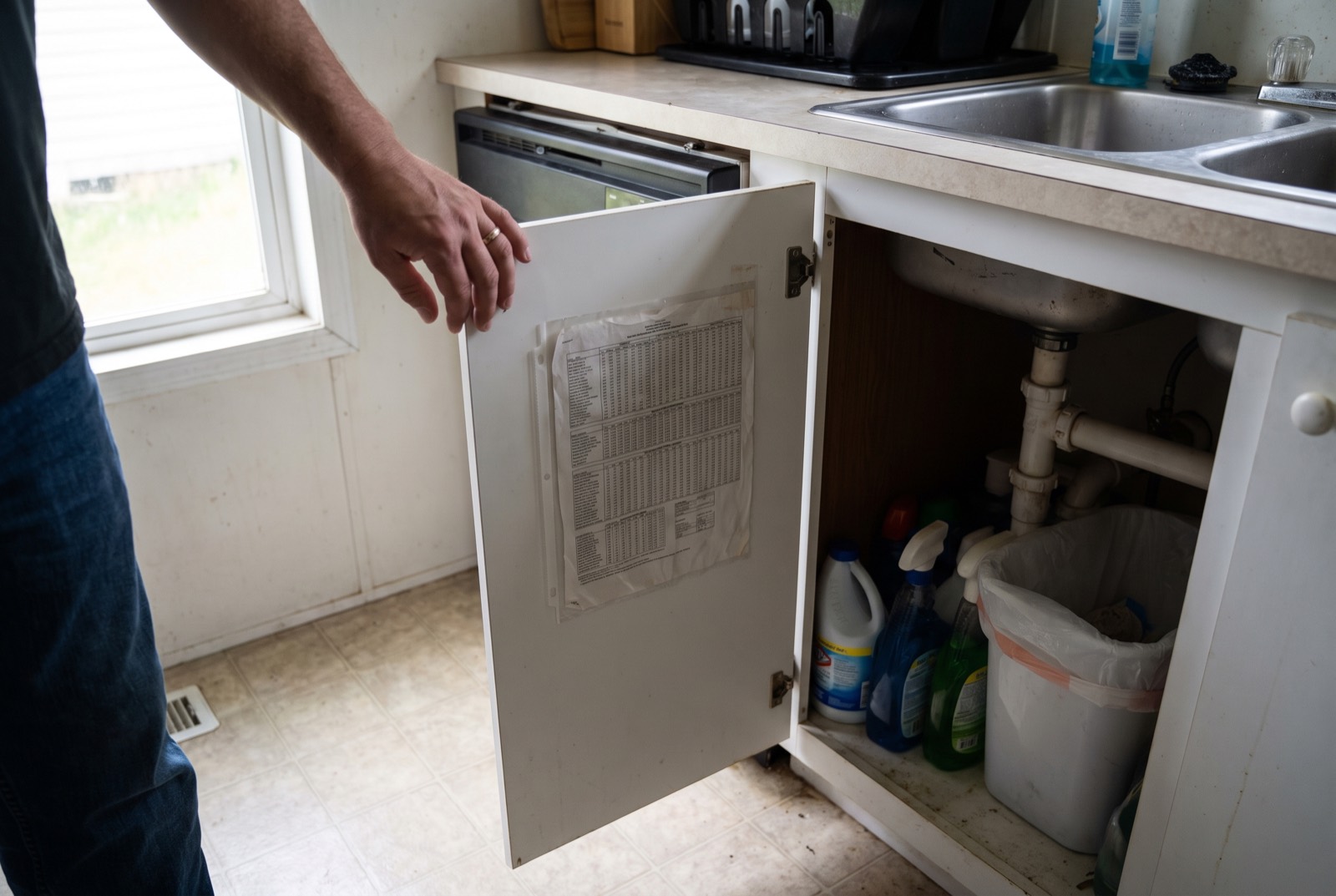
The HUD data plate is the home's interior label — installed at the factory before the home leaves the production line. It's the manufactured home's birth certificate: serial number, manufacturer name and plant location, model, date of manufacture, design loads, and the wind and roof zones the home was engineered for.
Manufacturers vary slightly in placement, but the four common locations are:
A complete data plate includes:
The PE locates the data plate, photographs it in full (a transcription-quality shot), transcribes the serial number and design loads onto the report's cover sheet, and confirms the wind and roof zones are appropriate for the installation location.
"A manufactured home shall be installed only in locations where the basic wind speed is equal to or less than the wind speed for which the home was designed."
In practice: a Wind Zone I home cannot be set in a Wind Zone III county. If the data plate and installation location are mismatched, the FHA structural certification cannot be issued — the home's design loads aren't engineered for the site.
A missing or illegible data plate is recoverable through the Letter of Plate Verification (LOPV) process — sourcing replacement information from the original manufacturer's factory build records.
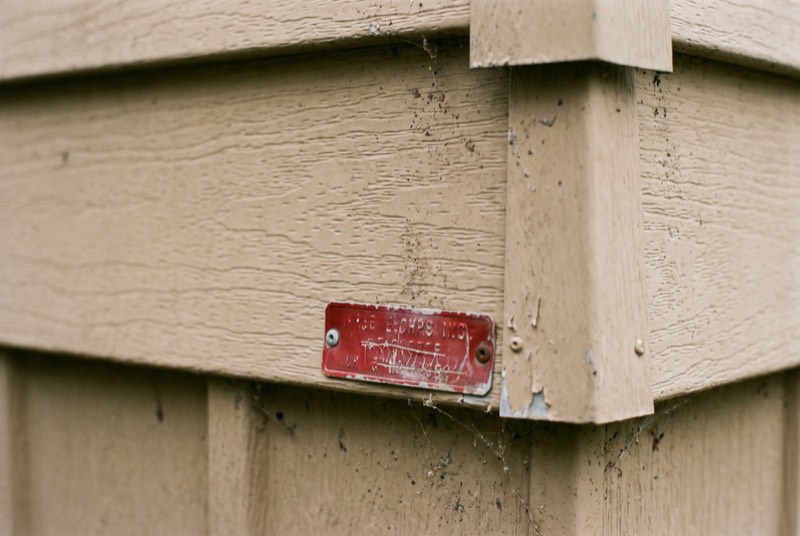
The home's exterior HUD certification label (the red label) carries a unique label number that ties back to factory build records. With that label number, the original manufacturer (or successor entity) can pull the home's specifications from build records and issue a Letter of Plate Verification — effectively re-issuing the data-plate content on manufacturer letterhead.
Typically 1–3 weeks depending on manufacturer responsiveness. Clayton, Champion, and Cavco have relatively prompt LOPV teams. Manufacturers that have dissolved without acquisition (some older brands, custom builders) can be slow or, occasionally, impossible to source from — in which case other documentation paths exist but the process becomes more complex.
If the data plate is missing, ask about available manufacturer records and confirm which verification document your lender will accept before requesting sourcing assistance.
The HUD certification label — commonly called the "red label" — is the home's exterior metal placard, one per transportable section. It certifies that the section was built in compliance with the HUD Manufactured Home Construction and Safety Standards in effect at the date of manufacture. It's the home's HUD-code-compliance evidence.
The standard placement is rear-corner-driver-side (left rear), but exceptions exist; some manufacturers placed the label on the front or side corner. The PE walks all corners of all sections to locate every required label.
The label is a small (typically 2″ × 4″) aluminum or stainless-steel placard with raised or engraved text:
The cert label is FHA's evidence that the home was built to HUD Code. Without it, the home's eligibility is at question — even if the home was clearly manufactured after 1976. F4 verification is more procedurally important than F3 in many ways: a missing data plate has a relatively quick LOPV path; a missing cert label has a longer and less-certain IBTS path.
A missing exterior certification label requires going through the Institute for Building Technology and Safety (IBTS), which administers HUD's manufactured-housing labeling program. This is a more complex and slower process than LOPV.
IBTS is a third-party administrator authorized by HUD to issue replacement certification labels when original labels are lost, damaged, or never installed. The process requires reconstruction of the home's manufacturing history — factory build records, the original IPIA (In-Plant Primary Inspection Agency) records, and HUD's central data files.
Typically 2–6 weeks depending on manufacturer record availability and IBTS workload. Older homes (pre-1990, particularly pre-1985) are slower and have lower success rates — factory records may have been lost or destroyed. We've successfully sourced replacement labels on most 1990s-and-later homes. Pre-1990 success rate is approximately 60–70% based on our trade experience.
For a missing exterior certification label, use the verification options described by HUD and IBTS. Confirm what records can be located and what your lender will accept.
An IBTS label verification letter confirms the home's certification label record. You request it from IBTS, which keeps the label records; have whatever identifies the home to hand, such as the label number, serial number and manufacturer. Fees are set by IBTS, not by the engineer, so check with them directly for current charges, and confirm with your lender which verification document it will accept before you pay for one. For a side-by-side look at the label, the plate and the foundation report, see our checklist comparing the HUD certification label, data plate and foundation report.
Rare but it happens, particularly on very old homes from defunct manufacturers. In those cases, FHA eligibility may be at risk. Alternative financing paths (conventional with specific lender flexibility, cash purchase, owner financing) may be necessary. We'll be straightforward about the prognosis at the IBTS-filing stage rather than letting expectations build.
HUD classifies manufactured-home design loads by two zone systems — Wind Zone (basic wind speed exposure) and Roof Load Zone (snow load and roof design). Both appear on the data plate; both must align with the installation location.
| Zone | Basic Wind Speed | Typical Geographic Area |
|---|---|---|
| Zone I | ≤ 70 mph | Most of the U.S. interior — including all of MO, AR, IL, KS, IA, NE, IN |
| Zone II | 100 mph | Selected Gulf Coast, Mid-Atlantic coastal counties |
| Zone III | 110+ mph | Hurricane-prone counties in FL, TX, LA, MS, AL, NC, SC |
| Zone | Roof Live Load | Typical Geographic Area |
|---|---|---|
| North | 40 psf | Northern tier states — heavy snow regions including IA, NE, IN |
| Middle | 30 psf | Most of the central U.S., including MO, IL, KS |
| South | 20 psf | Southern states with minimal snow — including AR |
The compatibility rule: the home's plate-rated zone must be equal to or more severe than the site's zone. A "North" roof-load home is fine in a Middle zone site; a "South" roof-load home in a North zone site is a problem — the home's roof wasn't engineered for the snow load. Most of our seven-state footprint is Wind Zone I. Cross-state moves are where zone mismatches occasionally surface.
Drop the property address, FHA case number, and timeline. Acknowledgment within one business day. Written quote same business day. Field visit confirmed within 24 hours. PE-sealed PDF in your underwriter's file in 24 hours from field visit.
FHA structural reports here; manufactured-home inspections, affixation documents, and aluminum wiring certifications through the rest of the firm. One engineer of record, licensed in seven states.
Visit the firmA new conventional financing path may require a post-move structural integrity inspection.
Get the moved-home structural integrity report →